
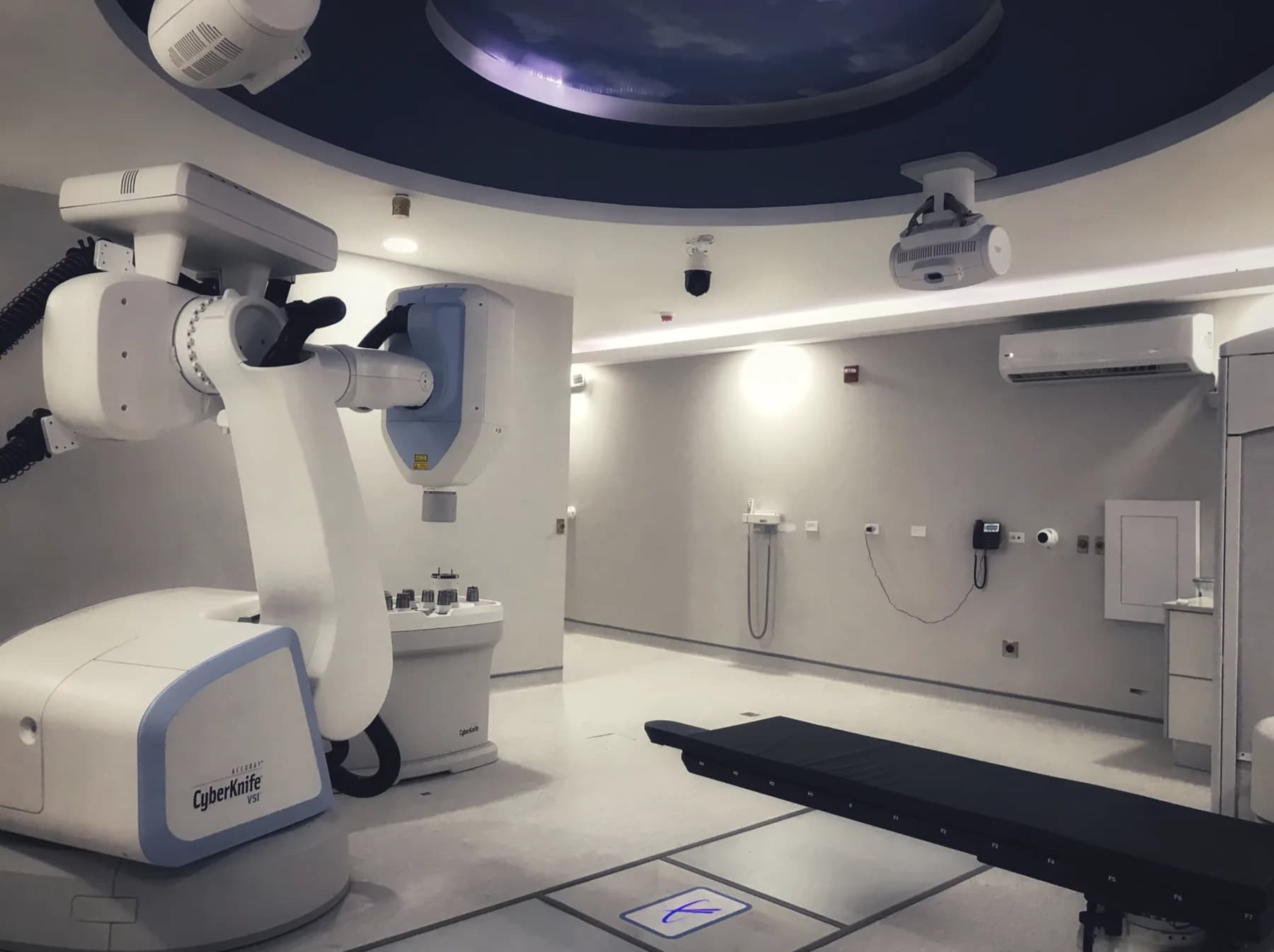
Patients at CyberKnife Costa Rica can receive my direct clinical involvement and oversight in neurosurgical radiosurgery through close collaboration with the on-site team in San José. From El Salvador, I can participate in case assessment, treatment-target definition, and planning review while working with the professionals responsible for delivering treatment and caring for the patient locally.
This approach allows specialist expertise to cross borders and can reduce unnecessary travel. It also continues a project I helped establish, which has expanded treatment options in Central America since 2019.
What Is CyberKnife?
What exactly is a “cybernetic knife”?
Despite its name, CyberKnife does not cut with a blade. It is a robotic radiosurgery system that directs radiation beams toward a target identified through medical imaging. It combines a compact linear accelerator, a robotic arm, and image-guidance systems to treat selected conditions in the brain and elsewhere in the body.
To me, it represents one of the most sophisticated applications of engineering to radiation therapy. Watching the robotic arm move around a patient is remarkable: it changes position to deliver radiation from multiple angles according to an individualized treatment plan.
Its “eyes” are imaging systems that verify target position and allow corrections. For certain treatments, the system can also compensate for breathing-related motion. Precision depends on the entire process, including imaging, patient selection, planning, quality assurance, and delivery.
Radiation is delivered without a surgical incision. Depending on the treatment site, additional preparation, such as marker placement, may be necessary. Suitability and the number of treatment sessions are determined individually.
Building Radiosurgery Expertise in Central America
My goal was to bring high-precision radiosurgery closer to patients in El Salvador. In 2014, we took a decisive step toward that goal. The introduction of CyberKnife treatments in Costa Rica in 2019 opened another chapter for me and the Centro Internacional de Cáncer.
A close business partner and I shared a phrase: “The best, or nothing.”
For me, that aspiration means much more than purchasing equipment. It means developing teams, reviewing outcomes, maintaining quality assurance, and recognizing when a patient would benefit from a different approach.
The development of Gamma Knife in El Salvador and CyberKnife in Costa Rica has allowed us to share expertise and expand our capabilities. CyberKnife extended our work beyond the skull, including selected spinal conditions. Both programs have contributed to our experience in functional radiosurgery and complex diseases of the nervous system.
The choice of technology should follow the patient’s needs and the quality of the treatment plan we can provide.
My Clinical Role and the Costa Rican Team
I welcome the responsibility of continuing to participate directly in neurosurgical radiosurgery treatments in Costa Rica. I have been involved with the project from its beginning and work alongside a team that has developed clinical and technical experience since 2019.
My role brings a neurosurgical perspective to the assessment: understanding the disease, considering alternatives, defining the treatment target, and identifying the neurological functions we must protect. This work is integrated with radiation oncology, medical physics, radiation therapy professionals, and the wider care team.
Remote collaboration allows us to review imaging, discuss cases, and evaluate plans without requiring patients to travel to El Salvador solely to obtain my specialist input.
Treatment takes place in person in Costa Rica, with the local team and the required safety checks. Remote clinical involvement complements that care through coordinated communication, documentation, and clearly defined responsibilities.
Expertise can cross borders while patient care remains close to home.
Which Conditions Can Be Evaluated?
Selected neurological conditions that may be considered include:
- Brain metastases and certain other brain tumors.
- Meningiomas, vestibular schwannomas, and pituitary tumors.
- Cerebral arteriovenous malformations.
- Trigeminal neuralgia.
- Spinal lesions and other conditions requiring specialist assessment.
Functional radiosurgery for refractory pain and selected movement disorders is another area of our experience and research. These applications require particularly careful selection, and some remain under clinical investigation.
Radiosurgery is not appropriate for every patient. Surgery, observation, medication, or another form of radiation therapy may offer a better option.
Research Connecting El Salvador and Costa Rica
Our collaboration has also produced scientific research.
One example is our joint publication on triple-target radiosurgery for intractable cancer pain, reporting experience from our centers in El Salvador and Costa Rica. The study included CyberKnife treatments in Costa Rica and brought a Central American clinical experience into the international literature.
These are preliminary findings that require further investigation. The work nevertheless reflects an essential commitment: asking clinical questions, documenting results, and submitting our experience to scientific scrutiny.
I want Central America to contribute to the development of radiosurgery worldwide. That requires evidence, professional training, and collaborations that extend beyond enthusiasm for a particular machine.
International Certification and Quality of Care
The Gamma Knife program at Centro Internacional de Cáncer in El Salvador and the Costa Rican Oncology Center CyberKnife hold certification from the International Stereotactic Radiosurgery Society (ISRS).
This certification recognizes clinical and technical practices assessed through external review, including patient selection, treatment planning, dosimetry, and care. It provides meaningful recognition of the team’s processes, although no certification guarantees an individual treatment outcome.
Quality also depends on everyday decisions: reviewing additional imaging, discussing alternatives, and taking the time to explain a recommendation.
Request a Case Review
If you or a family member would like to know whether CyberKnife in Costa Rica could be appropriate, an assessment can begin with a review of the diagnosis, imaging, and previous treatments. Depending on the case, this may include a remote consultation and coordination with the on-site team.
My commitment is to bring my neurosurgical and radiosurgical experience to that collaboration, helping provide an individualized recommendation and carefully planned treatment.
We developed these programs so that more Central American patients could access specialized care closer to home. Connecting the expertise of our countries remains part of that responsibility.
Request an assessment with Dr. Eduardo Lovo to explore neurosurgical radiosurgery options at CyberKnife Costa Rica.