
Radiosurgery Is Surgery. The Operating Room Simply Looks Different.
A reflection on surgical responsibility, precision, and the importance of keeping every valuable tool within the neurosurgical armamentarium.
Radiosurgery Is Surgery. The Operating Room Simply Looks Different.
By Dr. Eduardo Lovo
There is a philosophy I have defended throughout much of my professional career: intracranial radiosurgery is surgery. It is a surgical procedure that happens to take place in an operating room that looks very different from the one most neurosurgeons are accustomed to.
I believe this distinction must be understood and internalized, not only by the neurosurgical community but also by our colleagues in radiation oncology, medical physics, and everyone involved in the delivery of stereotactic radiosurgery.
There may be no incision, no microscope, no bleeding, and no instruments physically entering the brain. But none of these differences should diminish the surgical nature of what we do. We are intervening in the brain, targeting structures with millimetric precision, making decisions that can permanently alter neurological function, and accepting responsibility for the consequences.
The instruments are different. The responsibility is not.
The Obsession with Precision
Every neurosurgeon understands that surgery demands an almost obsessive attention to detail. A few millimeters can separate a successful operation from a devastating complication. The same is true in radiosurgery.
A radiosurgical procedure may appear deceptively simple to an outside observer. The patient lies on a treatment couch, a highly sophisticated machine delivers radiation, and there is no visible surgical wound.
Yet behind that apparent simplicity lies a sequence of decisions involving imaging, target definition, neuroanatomy, dosimetry, dose constraints, radiobiology, and clinical judgment. Each decision influences the next, and mistakes may have consequences that become apparent only months or even years later.
Radiosurgical procedures also vary enormously in complexity. Treating a small, well-defined lesion away from critical structures is not the same as addressing a complex arteriovenous malformation, a skull base tumor surrounding cranial nerves, or a functional target buried within intricate neural circuits.
As in open surgery, complexity and risk are not uniform. Experience matters. Judgment matters. Knowing when not to operate—or when not to irradiate—matters just as much as technical expertise.
The obsession with precision, planning, safety, and perfection must be exactly the same whether we hold a microsurgical instrument or plan a radiosurgical dose distribution.
A Tool That Neurosurgeons Cannot Afford to Ignore
Neurosurgery has never been defined by a single instrument or technique.
Our field has evolved through the introduction of microsurgery, endoscopy, lasers, stereotaxy, neuronavigation, intraoperative imaging, deep brain stimulation, focused ultrasound, and countless other innovations.
Radiosurgery belongs within that same armamentarium.
For decades, it has transformed the treatment of brain tumors, vascular malformations, trigeminal neuralgia, and selected functional disorders. It has also expanded the possibilities of treating patients for whom conventional surgery might carry unacceptable risks.
And yet, in some environments, radiosurgery remains strangely separated from mainstream neurosurgical thinking, as though it were a different discipline rather than another way of accomplishing a neurosurgical objective.
I believe that separation is a mistake.
Not every neurosurgeon needs to become a radiosurgeon. Just as not every neurosurgeon performs complex spinal instrumentation, skull base surgery, epilepsy surgery, or vascular neurosurgery, it is reasonable and necessary for us to develop areas of specialization.
But specialization should never become an excuse for ignorance of other effective treatments.
A neurosurgeon who does not perform radiosurgery should still understand its principles, indications, advantages, risks, and limitations. Likewise, a radiosurgeon should understand the surgical alternatives available to the patient.
Otherwise, we risk confusing the limits of our personal expertise with the limits of what medicine can offer.
Being a Radiosurgeon Does Not Make Me Less of a Surgeon
I continue to perform spinal fusions, complex spine procedures, skull base operations, and conventional intracranial surgery.
My involvement in radiosurgery has not diminished my commitment to the conventional operating room. On the contrary, I believe each discipline has made me better at the other.
Microsurgery provides a profound understanding of anatomy, surgical risk, tissue relationships, and the consequences of neurological injury. Radiosurgery adds another perspective: one that forces us to consider not only anatomical structures but also dose distributions, radiobiological effects, functional networks, and the evolution of tissue responses over time.
In skull base surgery, for example, the objective is not always to remove every last cell of a tumor at any cost. Sometimes a carefully planned subtotal resection followed by radiosurgery can offer a better balance between disease control and neurological preservation.
These are not competing philosophies. They are complementary strategies.
The same reasoning applies to functional neurosurgery, where deep brain stimulation, lesioning, focused ultrasound, and radiosurgery may offer different approaches to modifying neural circuits. Each has its own evidence, limitations, reversibility, and risk profile.
Understanding these alternatives allows us to make better decisions.
Being a radiosurgeon does not excuse me from performing anything less than excellent surgery in the conventional operating room. Nor should being an accomplished microsurgeon excuse anyone from understanding radiosurgery.
We should be surgeons first, not defenders of a particular instrument.
The Different Operating Room
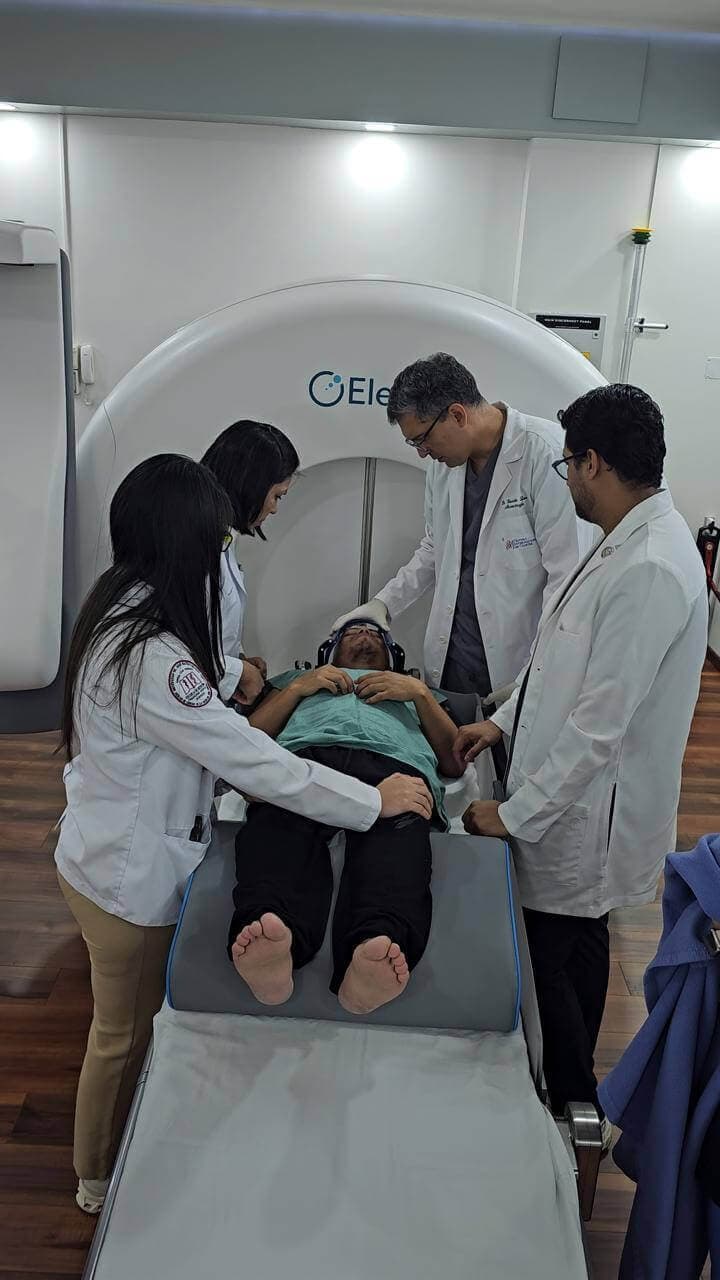
Recently, during a busy day at CIC | Centro Internacional de Cáncer in El Salvador, we prepared a patient for intracranial radiosurgery under general anesthesia.
For someone unfamiliar with the discipline, the scene might look unusual. Anesthesia equipment, immobilization systems, imaging, treatment planning, radiation delivery, and an entire team coordinating a procedure in which no conventional incision will be made.
But to me, it is unmistakably an operating room.
It is a space where patients entrust us with their brains, their neurological function, and often their last reasonable opportunity for treatment.
General anesthesia adds another layer of coordination and responsibility, but it is not what makes radiosurgery surgical. Many radiosurgical procedures are performed with patients fully awake. The surgical character lies in the deliberate intervention, the precision required, the clinical judgment behind it, and the responsibility for its outcome.
I have watched radiosurgery evolve from a highly specialized treatment for a relatively narrow group of conditions into an increasingly versatile neurosurgical discipline. Today, developments in functional imaging, tractography, connectomics, and advanced treatment planning are opening possibilities that would have seemed extraordinary just a generation ago.
These advances are exciting, but they also demand restraint. Technical capability does not automatically establish clinical benefit. New applications must be examined with scientific rigor, appropriate patient selection, and a clear understanding of the evidence.
The more sophisticated our tools become, the greater our obligation to use them responsibly.
Our Loyalty Is to the Patient
Perhaps the most important lesson from practicing both conventional neurosurgery and radiosurgery is that the question should never begin with What procedure do I prefer?
It should begin with What does this particular patient need?
Sometimes the answer is microsurgery. Sometimes it is radiosurgery. Sometimes it is a combination of both. Sometimes it is observation, medical treatment, or referral to a colleague whose expertise is better suited to the problem.
We should never allow professional identity, institutional boundaries, or personal technical preferences to determine the options we present.
The purpose of a neurosurgical armamentarium is not to demonstrate how many procedures we can perform. It is to ensure that patients have access to the most appropriate treatment for their condition.
I believe our training, multidisciplinary collaboration, and professional culture should reflect that principle.
Radiosurgery deserves to be understood as an integral part of neurosurgery—not because it must replace conventional surgery, but precisely because it expands what surgery can accomplish.
And the same standards that define excellence in a conventional operating room must follow us into the radiosurgical suite.
Different operating room. Same surgical responsibility. Same pursuit of excellence.
Dr. Eduardo Lovo is a neurosurgeon and radiosurgeon at CIC | Centro Internacional de Cáncer, El Salvador.